

The Bottom Line

CMS is evaluating a structural shift where the quality of your data infrastructure directly dictates the success of your reimbursement. In this model, access is the baseline for accountability.


From Access to Outcomes: A Ten-Year Pivot

For years, healthcare policy was obsessed with breaking down silos. The focus was on the “pipe,” ensuring data could move. The ACCESS (Advancing Chronic Care with Effective, Scalable Solutions) model moves the focus to the “payload.”
This voluntary, ten-year Medicare Innovation Center model moves chronic care away from visit-based reimbursement toward Outcome-Aligned Payments. Rather than paying for the activity of treating diabetes or hypertension, CMS is paying for the result.

What ACCESS is Really Testing

ACCESS is not just a new code to bill. In fact, it is a test of operational scalability. It targets high-prevalence conditions (hypertension, diabetes, COPD, chronic pain, and depression) within Original Medicare Part B. This helps prevent over resourcing low-risk patients while focusing on high-impact groups. This payment model is scheduled to begin in July 2026
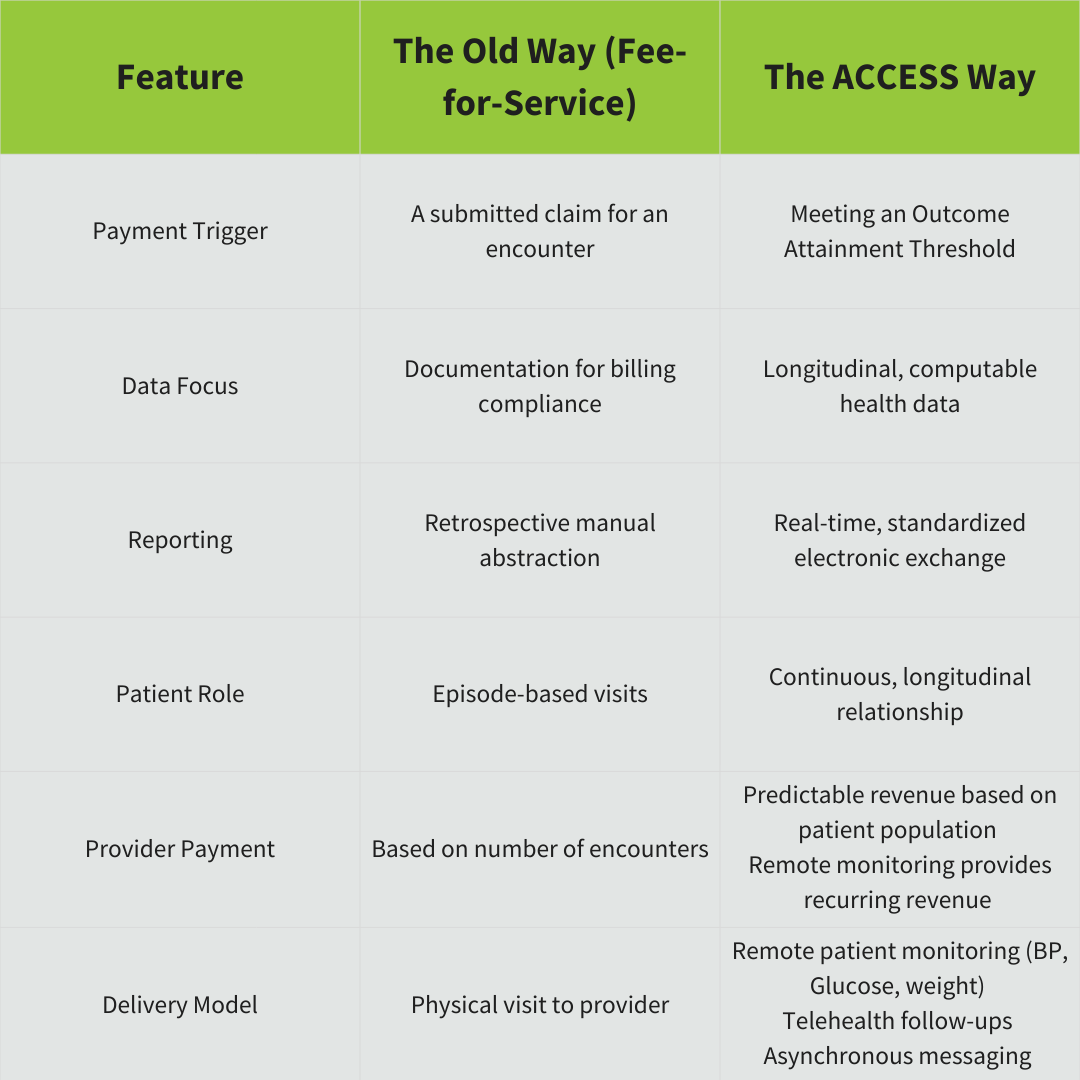

Reporting: Compliance to Computation

CMS has signaled that “narrative attestation” is dead. Under ACCESS, the system itself becomes evidence.
Practices must capture baseline and follow-up measurements, such as A1c levels or PHQ-9 scores, and demonstrate improvement at the patient level. This requires data that is structured, standardized, and computable. While final API standards are forthcoming, the direction is clear: FHIR-based interoperability and multi-source data ingestion (EHRs, labs, and devices) are no longer “nice-to-haves.” They are financial imperatives.

Infrastructure as Exposure: The Risk of "Dirty" Data

As data flows more freely under ACCESS, gaps in infrastructure become financial liabilities.
The Reality Check: If your organization lacks longitudinal tracking or “outcome normalization,” you will struggle to prove performance even if your clinical care is excellent.
When outcome data feeds payment, small inconsistencies compound:

  • Missing Baselines: A missing measurement makes future improvement invisible to CMS.
  • Data Lineage Gaps: If you cannot trace the origin of a lab value, it may be excluded from your Outcome Attainment Rate.
  • Transformation Errors: Undocumented changes to data during exchange can undermine the auditability of your results.
    In this sense, ACCESS turns data access into data responsibility. Once information enters your system, you own its accuracy and its interpretation.

The Convergence with AI and Governance

ACCESS arrives exactly as healthcare expands its use of AI. When CMS data becomes the input for AI-driven population health strategies, explainability becomes an operational necessity.
Organizations must be able to answer: Where did this data come from? How was it transformed? Who oversaw the process?

Digital Intake: The "Data Generator"

While CMS does not mandate digital patient intake, it is the most efficient engine for the ACCESS model. Screening patients for screeners in patient intake like SDOH, PHQ9 builds the baseline data.
1. Systematic Baseline Capture: Ensuring every patient has a recorded outcome score at the start of care.
2. Reduced Burden: Moving data collection out of the exam room and into the patient’s hands.
3. Longitudinal Monitoring: Capturing Patient-Reported Outcomes (PROs) between visits to ensure the “Outcome Attainment” is sustained.

A HealthAsyst Perspective: Building the Foundation

At HealthAsyst, we see the ACCESS Model as a signal that healthcare data strategy is entering a new phase. Outcome-based care at scale requires more than just a connection to an HIE. It requires an infrastructure built for traceability and continuous measurement.
Digital Intake platforms like HealthAsyst’s CheckinAsyst and our clinical analytics solution, Insights, are designed to help organizations adapt to this changing paradigm.
The CheckinAsyst solution can help with Telehealth visits, between visiting touch points through messaging features to patients, capturing data for vitals, weight, screeners like SDOH, PHQ9 etc., provider automated reminders where required.

The Insights solution enables the successful recording of Patient-Reported Outcome Measures (PROMs) and helps track patient screenings for Annual Wellness Visits (AWVs) and other critical assessments. It also helps in monitoring the adherence of the patients and identify potential misses early for automated outreach campaigns. Specifically, our tools help practices to:

  • Track Orthopedic Measures: Monitor metrics like Osteoporosis Management, functional status after lumbar fusion, and screening for fall risks.
  • Forecast Behavioral Health Performance: Gain credible forecasts on measures tailored to pediatric and behavioral health, including depressive disorders, suicide risk assessments, and depression screenings.

Organizations that treat ACCESS as an infrastructure challenge, investing in interoperable architectures and disciplined data models, will be positioned to lead the next decade of value-based care.

No content found

Author

  • Satish Narasimhan

    Satish brings with him an experience close to 25 years in the IT industry with a strong background in IT services delivery in Healthcare, Airline, Telecom, and Offline Sales domains. Satish has rich experience in successfully leading large product development engagements for various clients in a multi-vendor environment with globally distributed teams.

    View all posts
Close Menu