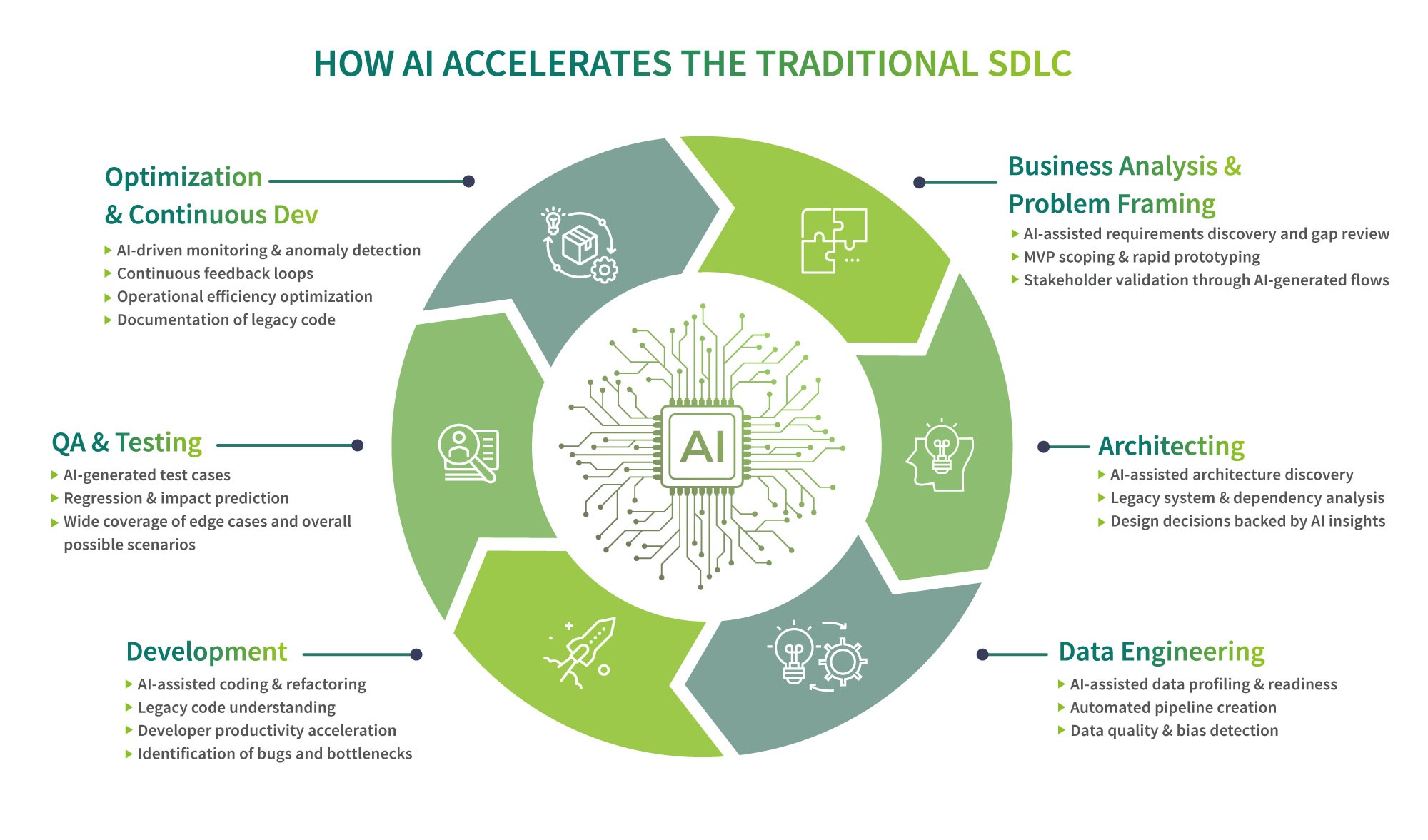
For years, the Software Development Life Cycle (SDLC) has been represented as a structured sequence of steps: business analysis, prototyping, MVPs, design, development, testing, deployment, and maintenance. This model served organizations well in an era where software systems were largely deterministic, release cycles were longer, and change was incremental.

That world still exists, but it has expanded. Today’s software delivery reality includes rapid MVP builds, continuous prototyping, frequent iterations, and faster feedback loops driven by evolving user expectations and competitive pressure. At the same time, recent advancements in Artificial Intelligence are reshaping how each stage of the SDLC can be executed.

AI does not invalidate the traditional SDLC. Instead, it introduces an opportunity to rethink and enhance it, unlocking new gains in efficiency, speed, and accuracy across discovery, design, build, test, and post-deployment optimization.

Today, healthcare technology teams face fragmented data, legacy platforms, evolving regulations, and increasing pressure to deliver faster without compromising quality.

This is where we need to consider how seamlessly AI can be infused into distinct stages of the SDLC and discard redundancy. At HealthAsyst, our experience in using AI to has given us a unique vantage point to accelerate rapid iterations with quick prototyping, stakeholder feedback, reduction of ambiguity, and strengthening of execution across the lifecycle. 

To be sure, this infusion of AI into various stages of the traditional SDLC is not about elimination of human effort or supervision, but rather a co-piloting of each stage with an AI-human combined effort—the widely popular concept of the “human in the loop.”

Human supervision provides guardrails that proofs against errors. AI accelerates the manual processes in the SDLC, and yields speed, accuracy, and efficiency.


Let me illustrate this through real-world examples.

Business Analysis: From Assumptions to Clarity

Traditional business analysis relies heavily on documentation, workshops, and iterative discussions to document user requirements and stories. While these remain important, AI dramatically improves the speed and depth of early discovery. AI enables faster documentation of requirements and even reviewing gaps in requirements, helping teams cover all bases.

Tools used: Lovable, Replit, Cursor

Case in point:
For a HealthTech start-up building a Value-Based Care (VBC) analytics platform, the initial input was to create a platform which aggregated data from various stakeholders (providers, payers, external sources). It then transformed the data and applied healthcare-specific analysis.
Built on top of this analytics engine were three purpose-built solutions, each addressing a specific facet of healthcare delivery: A care coordination platform, a care optimization solution, and a care engagement system.

The platform would provide real-time insights on Membership data, Predictive Risk, and Total Cost of Care.

Before the prototyping could begin, the team used AI to interpret ambiguous requirements, clarify stakeholder intent, and to validate what should be built before committing to build. All these actions reduced uncertainty early in the lifecycle. As a result of these early actions, the team was able to create a visual, navigable representation of the proposed solution. Stakeholders were able to review the workflows and drilldowns. As a result, clarity and alignment were achieved.

The AI-assisted discovery process accelerated requirements elaboration, enabled early stakeholder validation and helped shape the product roadmap.

This approach enabled faster stakeholder alignment, clearer prioritization of features, and early validation of workflows, reducing discovery time from several weeks to just ten days.

AI, in this stage, compressed ambiguity into clarity early, preventing costly rework.

Architecting: Designing with Foresight

Architecture decisions in healthcare are difficult to reverse. Poor visibility into legacy systems or integration constraints can derail modernization efforts before they begin. Further, architecting requires taking a long-term view of technology, business requirements, and needs that scale with increasing volume and transactions.

Tools used: Mermaid.js, PlantUMLw

Case in point:

A regional diagnostic lab in the western United States needed to modernize a heavily customized Laboratory Information System (LIS) but faced limited documentation and a shrinking pool of internal system expertise. Instead of relying solely on manual analysis, AI was applied to interpret and navigate the legacy codebase at scale.

Through AI-assisted code understanding, the team was able to surface embedded business rules, workflow logic, and system dependencies, providing architects with a clear, current-state view of how the platform functioned.

This clarity enabled architects to design forward with confidence: redefining system boundaries, reshaping workflows, and intentionally architecting a next-generation LIS aligned with modern interoperability and future agentic AI capabilities.

In this scenario, AI did not replace architectural judgment; it made informed design possible at scale.


Data Engineering: Making Data Usable, Not Just Available

Healthcare organizations often have plenty of data, but little of it is structured, consistent, or ready for analytics and automation.

AI strengthens intelligent data ingestion and mapping across EHRs, claims, devices, and third-party sources. Further, AI-assisted normalization, feature discovery, and labelling workflows are clear gains. Further, AI helps in automated detection of missing, imbalanced, and noisy healthcare data. It helps design secure pipelines aligned with privacy and access controls.

Tools used: Mermaid.js, PlantUMLw

Case in point:

For a diagnostic lab processing thousands of requisitions, insurance documents, and IDs daily, manual document handling was limiting scale and accuracy. AI-powered OCR and document classification were used to automatically extract, classify, and score confidence levels across documents, creating a reliable data foundation within seconds.

Similarly, for a wound care solutions provider, AI and OCR digitized fax-based VAC order forms, reducing delays and improving data accuracy for downstream processing.

In both cases, AI transformed data engineering from a manual bottleneck into a scalable, intelligent foundation.


Development: Accelerating Without Compromising Quality

In healthcare software delivery, development velocity is often constrained not by feature complexity, but by the effort required to build, integrate, and repeatedly modify systems that rely on manual, error-prone processes.

Tools used: Cursor, Copilot, Windsurf, Claude Code, CodeRabbit

Case in point:

AI-assisted development, using tools like GitHub Copilot, Claude, and similar coding copilots, fundamentally changes how software is built by reducing friction across the development lifecycle. By generating context-aware code, suggesting patterns, and flagging potential issues early, these tools help teams avoid common errors before they make it into production. Developers spend less time on repetitive tasks like boilerplate code, debugging, and refactoring, and more time on higher-value problem solving and architecture decisions. The result is faster development cycles, fewer defects, and improved consistency across codebases.

QA: From Reactive Testing to Predictive Assurance

Testing has traditionally been one of the most time-consuming stages of the SDLC. AI enables a shift from reactive testing to proactive quality assurance.

Tools used: Cursor, Playwright framework

Case in point:

The customer, a leading digital patient engagement platform in the U.S. faced the key challenge of data retrieval issues due to various technical reasons. Manual verification of nightly jobs for 55 customers was time-consuming and error prone. 

We were able to use AI to log in, capture dashboard data on patient appointments, and update data for each live customer. We developed comparative capability around weekly appointment trends to detect job successes or potential issues. Further, we highlighted potential issues for quick resolution and manual validation if needed. 

The value we delivered accelerated debugging and brought about 15% resource optimization. Around 2-3 hours were freed per support resource per day. Failed jobs could be detected earlier and resolved before business hours.


Optimization & Continuous Development: Systems That Learn

The most significant impact of AI is often realized after deployment, when systems are operating in real-world conditions. In this phase, AI enables continuous optimization by observing live behavior, identifying patterns and anomalies, and feeding actionable insights back into operations and development.
Case in point:
AI-powered wound assessment solutions built by us used image analysis to measure wound characteristics, predict healing progression, and recommend optimal dressing materials. As more data was captured, the system continuously improved predictions, enhancing clinical decision-making and strengthening evidence for payors.
This is the future of healthcare software: systems that learn from real-world usage and improve over time, rather than remaining static after release.

A New Mental Model for the SDLC

The SDLC can no longer be viewed as a linear handoff from one team to another. In our AI-enabled model, intelligence sits at the center, feeding insights forward and pulling feedback backward across stages.

AI allows teams to move faster without guessing, innovating without losing control, and modernizing without unnecessary risk.

As healthcare organizations prepare for an increasingly intelligence-driven future, rethinking the SDLC is no longer optional. The question is not whether AI belongs in the lifecycle, that it certainly does, but how intentionally it is woven into it.

At HealthAsyst, that intentionality defines how we build, modernize, and scale healthcare technology.


Author

  • Arjun Bajaj

    Arjun Bajaj is a seasoned Pre-Sales and Business Development leader with 14 years of experience driving sales and consulting engagements for fintech and healthcare IT clients. Currently, at HealthAsyst, he leverages his expertise in go-to-market strategies and business partnerships to foster growth and shape impactful sales strategies within the U.S. healthcare sector.

    View all posts
Close Menu