

The Age of Agentic AI in US Healthtech is Here
From the neon-lit booths of the HIMSS26 conference to the sterile hallways of suburban hospitals, artificial intelligence is reshaping American healthcare faster than the industry can validate, regulate, or pay for it. In 2026, the sector has officially moved past the “promising pilot” phase. We are witnessing a fundamental transition from Generative AI to Agentic AI.
However, as we build the plane while flying it, the “distribution” of this revolution remains its greatest challenge.
1. HIMSS 2026: The Rise of the Autonomous Agent
The defining message from industry giants like Google, Microsoft, and Epic this year is clear: AI agents are ready for autonomy. We are moving toward a reality where “specialized digital coworkers” handle multi-step tasks, from triage to revenue cycle management, with minimal human prompting.
- The Revenue Cycle Champion: Tools like XiFin’s Autonomous Appeals Agent are transforming billing. Instead of a specialist manually fighting a denied claim, the agent extracts clinical evidence from the EHR and submits the appeal in near real-time, turning a 10-day headache into a seamless transaction. Case in point:
- The Clinical Orchestrator: Partnerships like the integration of Wolters Kluwer’s UpToDate into Microsoft Dragon Copilot allow AI to ambiently listen to patient visits, suggest treatments, and draft specialty-specific notes simultaneously. It’s estimated to save clinicians up to 43 minutes per day, roughly five weeks of administrative time per year.
2. Regulation & Adoption: Crossing the Inflection Point
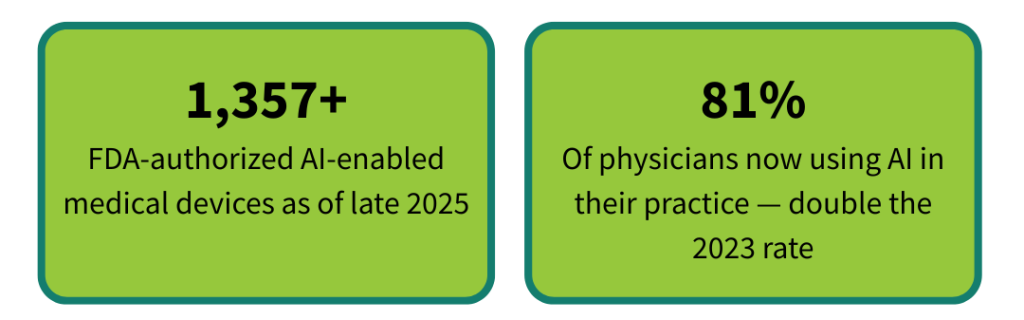
The FDA is moving with unexpected agility to keep pace with this innovation. As of late 2025, there are over 1,357 FDA-authorized AI-enabled medical devices.
Recent milestones include:
- De Novo Authorizations: The FDA is creating new regulatory boxes for “first-of-their-kind” tech, such as AI-powered gestational age estimation tools.
- Physician Trust: A fresh AMA survey of 1,700 physicians shows that AI adoption has doubled since 2023. 81% of doctors now use AI, and more importantly, 76% believe it actively improves patient care rather than just easing paperwork.
3. The infrastructure: Robots and Risks
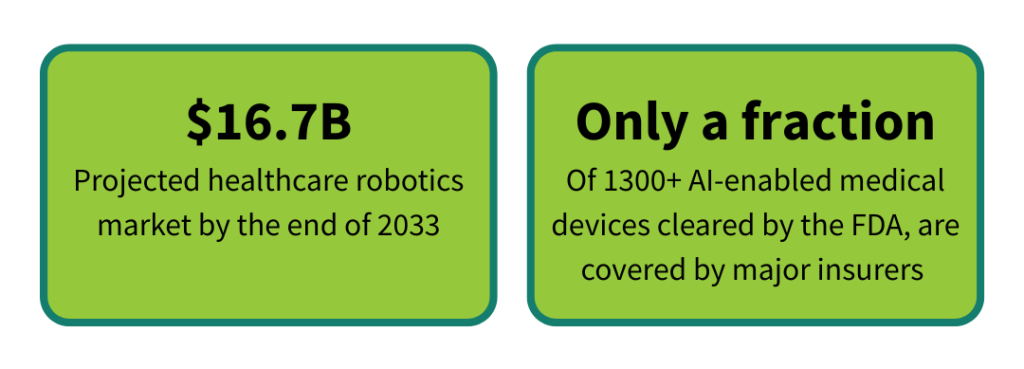
The physical footprint of AI is now visible in hospital corridors. The Healthcare Robotics Market is estimated to be valued at USD 10.6 Bn in 2026. This market size is expected to grow to USD 16.7 Bn by 2033.
However, this connectivity comes with a cost. AI-enabled social engineering and ransomware are the most persistent threats facing health systems today. Data governance has shifted from a “compliance checkbox” to a “clinical delivery requirement,” because when the network goes dark, patient safety is immediately at risk.
4. The Challenges: The “Reimbursement Wall” and the “Black Box”
Despite the technological triumphs, two major barriers prevent universal distribution:
- The Billing Black Hole: While the FDA has cleared over 1,300 devices, only a fraction are covered by major insurers. The technology is ready, but the payment rails are stuck in the past. The coming battles over CMS reimbursement policy will shape the sector more than any product launch.
Explainability: The “Black Box” nature of AI remains a primary weakness. To build trust, the industry is adopting the ISO/IEC 42001 certification.
ISO/IEC 42001 specifies how organizations must establish, implement, maintain, and continually improve an AI Management System (AIMS). It is designed to ensure responsible and transparent AI use across industries.
The standard emphasizes traceability, transparency, and reliability as foundational principles.

The Verdict
Disclaimer:
This blog is intended solely for informational and educational purposes. All company names, product names, trademarks, and registered trademarks mentioned in this article are the property of their respective owners and are used here for identification and descriptive purposes only. Their inclusion does not imply any affiliation, endorsement, or sponsorship.
References:
IntuitionLabs: FDA AI Medical Device Tracker (Revised March 2026)
AMA: More than 80% of physicians use AI professionally
Coherent Market Insights: Healthcare Robotics Market Share & Analysis 2026-2033
XiFin Press Release: Empower AI RCM Ecosystem
Wolters Kluwer: Clinical intelligence in Microsoft workflows
Author
-
Satish brings with him an experience close to 25 years in the IT industry with a strong background in IT services delivery in Healthcare, Airline, Telecom, and Offline Sales domains. Satish has rich experience in successfully leading large product development engagements for various clients in a multi-vendor environment with globally distributed teams.
View all posts

