

Healthcare interoperability has become a strategic priority for healthcare organizations, healthtech companies, and digital health platforms. Yet despite advances in FHIR, APIs, cloud technologies, and interoperability standards, many healthcare interoperability projects fail to achieve their intended outcomes.

Often, healthcare interoperability solutions struggle because of workflow complexity, integration variability, legacy systems, and the challenges of exchanging information across multiple healthcare ecosystems.

Understanding these challenges is critical for organizations looking to improve healthcare data interoperability and build scalable interoperability solutions in healthcare.

Why Healthcare Interoperability Projects Are More Difficult Than Expected

Many organizations assume interoperability is simply a matter of connecting systems and exchanging data. Healthcare data interoperability requires organizations to connect not only systems, but also workflows, business processes, and operational requirements.
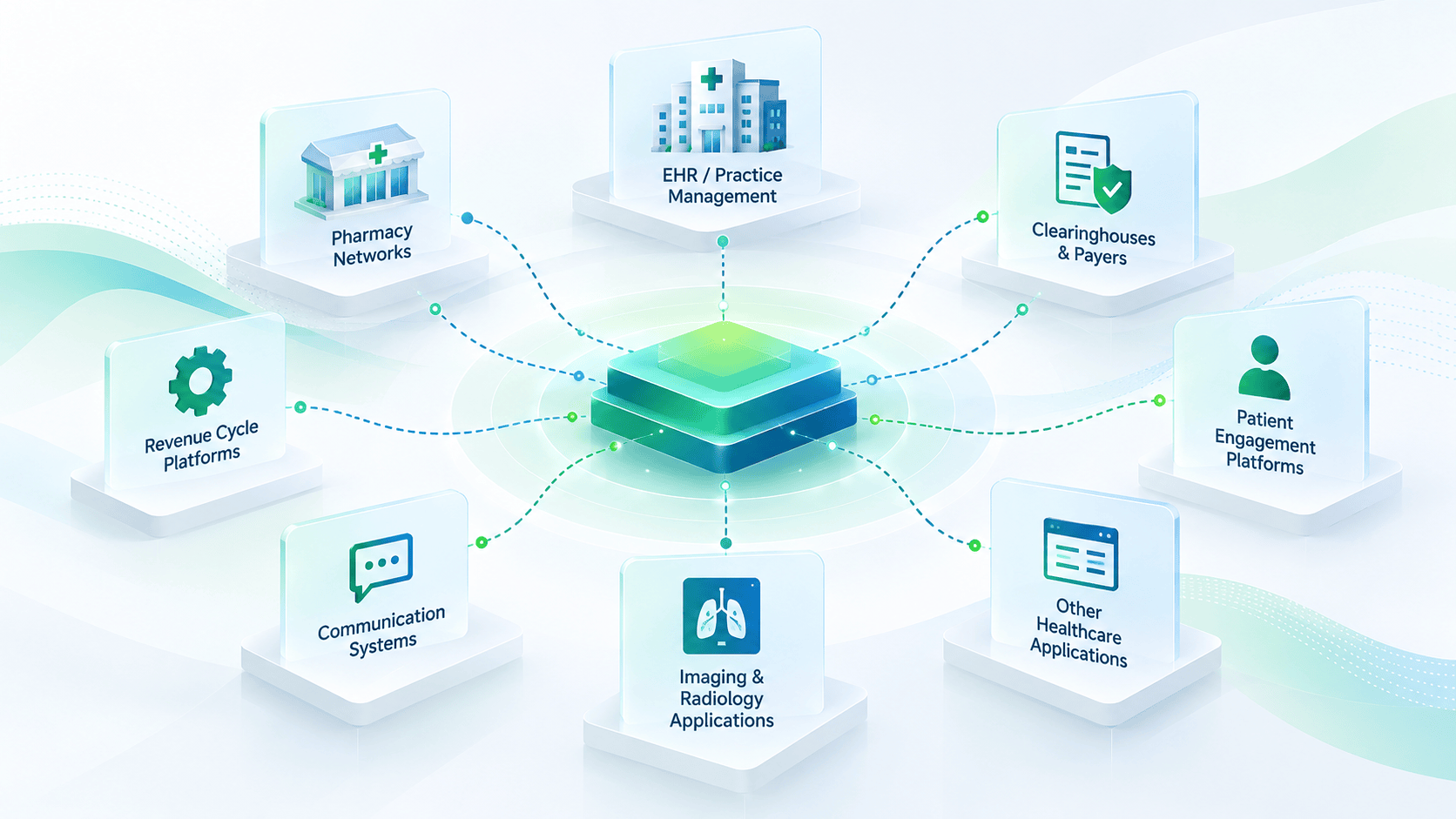
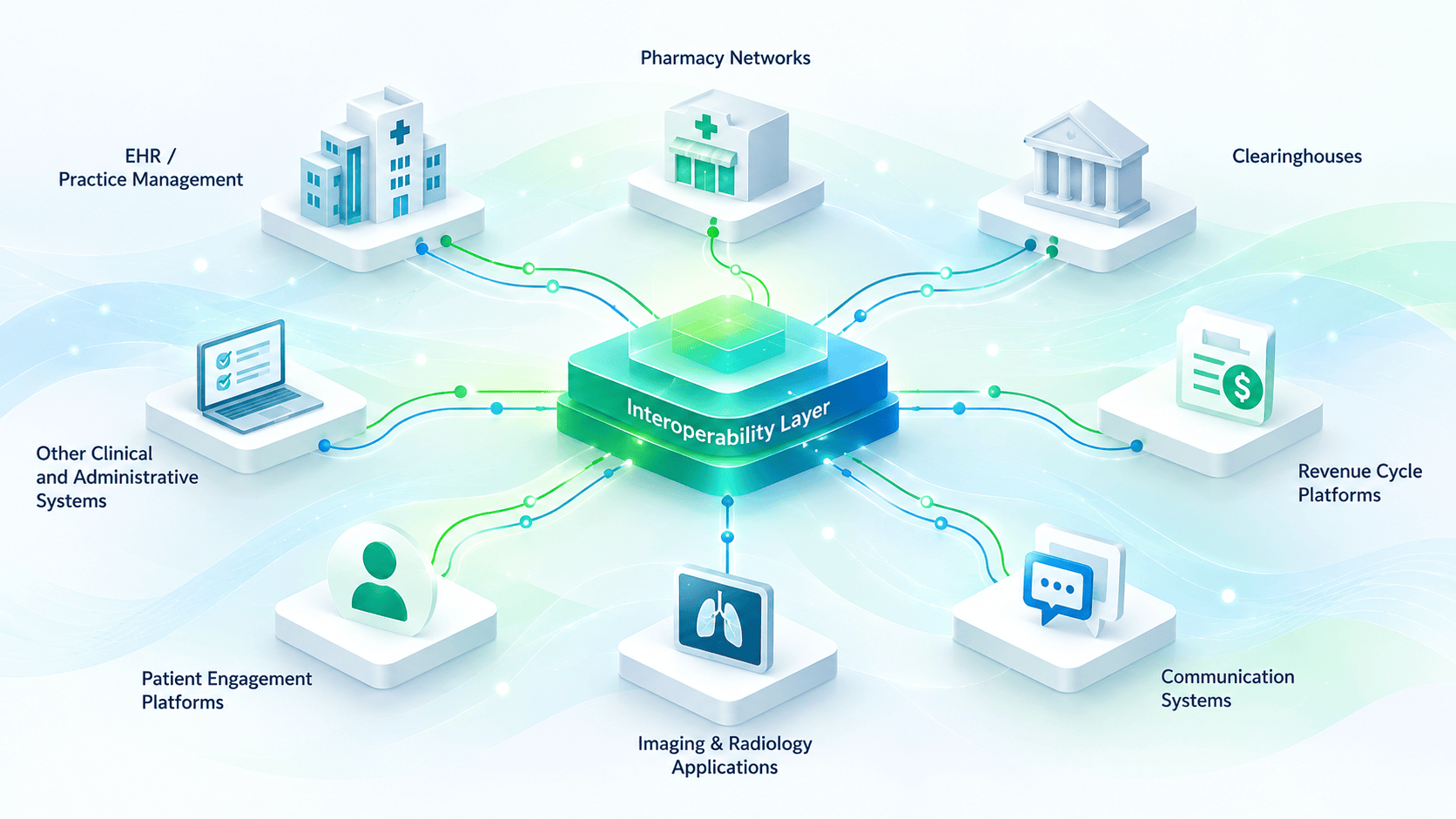
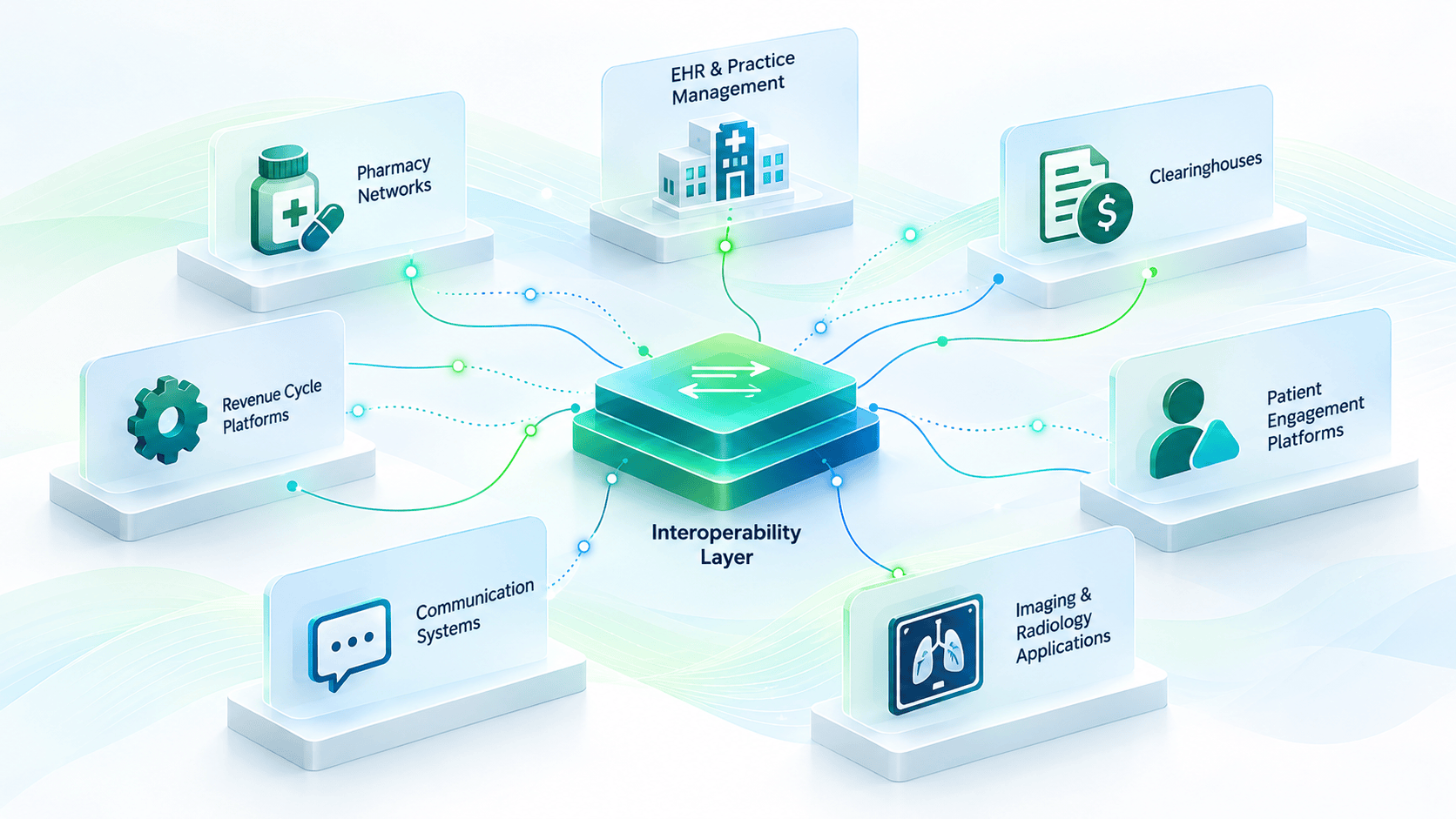
Healthcare interoperability solutions often involve integration across:

  • EHR and Practice Management systems
  • Pharmacy networks
  • Clearinghouses
  • Revenue cycle platforms
  • Patient engagement platforms
  • Communication systems
  • Imaging and radiology applications

Each ecosystem introduces unique integration challenges that can impact project success.

Challenge #1: Multiple EHR Ecosystems with Different Rules

One of the biggest challenges of interoperability in healthcare is the lack of consistency across EHR platforms.
Although EHRs support many of the same clinical and administrative workflows, each platform may provide:

  • Different APIs
  • Different authentication models
  • Different data structures
  • Different workflow requirements
  • Different implementation limitations

As organizations expand into new customer environments, interoperability solutions in healthcare must adapt to each ecosystem without creating excessive customization or technical debt.

Impact on Healthcare Data Interoperability

When interoperability architectures are not designed for platform variability, organizations often experience:

  • Longer implementation timelines
  • Higher integration costs
  • Increased maintenance effort
  • Reduced scalability

Challenge #2: Workflow Integration Matters More Than Data Exchange

Many interoperability initiatives focus on moving data between systems. However, healthcare interoperability is ultimately about supporting workflows.

For example:

  • Scheduling workflows
  • Patient registration workflows
  • Eligibility verification workflows
  • Clinical documentation workflows
  • Payment posting workflows
  • Medication prescribing workflows

Successful healthcare interoperability solutions ensure that data arrives in the right place, at the right time, within the right workflow.
Simply exchanging data does not guarantee interoperability success.

Challenge #3: Balancing Standards and Real-World Requirements

FHIR has become a foundational technology for healthcare data interoperability.

However, organizations frequently discover that standards alone do not address all business requirements.

Many interoperability initiatives still require a combination of:

  • FHIR APIs
  • HL7 messaging
  • SMART on FHIR workflows
  • Proprietary APIs
  • Vendor-specific interfaces
  • Custom business logic

Organizations that rely exclusively on standards-based approaches often encounter limitations when supporting real-world workflows.

The most effective healthcare interoperability solutions combine standards-based interoperability with practical integration strategies. 
Challenge #4: Pharmacy and ePrescribing Connectivity

Pharmacy interoperability introduces an entirely different set of challenges.

Electronic prescribing, medication history retrieval, electronic prior authorization, and controlled substance workflows often require connectivity with external pharmacy networks.

Challenges frequently include:

  • Transaction reliability
  • Regulatory requirements
  • Workflow synchronization
  • Integration complexity across multiple stakeholders
Because pharmacy workflows directly impact patient care, organizations must prioritize reliability, accuracy, and compliance when implementing healthcare interoperability solutions. 

Challenge #5: Clearinghouse and Revenue Cycle Integration

Healthcare data interoperability extends far beyond clinical systems. 

Organizations often need to exchange information with clearinghouses and payer ecosystems to support: 

  • Eligibility verification 
  • Claims processing 
  • Benefits checking 
  • Payment workflows 
  • Financial reconciliation

These integrations introduce additional complexity because they involve:

  • Transaction-based workflows 
  • X12 standards 
  • External partner dependencies 
  • High-volume data exchange 

Challenge #6: Poor Scalability

A healthcare interoperability solution that works for one integration does not automatically scale to many. 

Organizations frequently experience issues when onboarding new customers because each implementation requires: 

  • Custom development 
  • New mappings 
  • Workflow adjustments 
  • Additional testing

Over time, these point-to-point integrations become difficult to maintain.

This lack of scalability is one of the most common reasons interoperability projects become expensive and difficult to support.


How to Improve Healthcare Interoperability Success Rates

Organizations can improve healthcare interoperability outcomes by adopting several best practices.

Build Reusable Integration Frameworks
Reusable integration patterns help reduce complexity and accelerate future implementations.

Standardize Data Exchange
Using canonical data models can simplify healthcare data interoperability across multiple systems.

Design for Future Integrations
Interoperability architectures should be built to support additional EHRs, pharmacy platforms, clearinghouses, and external applications.

Prioritize Workflow Alignment
Successful interoperability solutions in healthcare focus on supporting business processes, not just moving data.

Plan for Ecosystem Diversity
Healthcare organizations should expect to work across multiple standards, APIs, vendors, and integration approaches.
Lessons Learned from Real-World Healthcare Interoperability Projects

The most successful healthcare interoperability initiatives treat interoperability as an ongoing capability rather than a one-time project. 
Organizations that build flexible, scalable healthcare interoperability solutions are better positioned to expand into new markets, support additional healthcare ecosystems, and respond to changing business requirements. 
As healthcare continues its digital transformation journey, healthcare data interoperability will remain a foundational requirement for connected care, operational efficiency, patient engagement, and innovation. 
Ultimately, organizations that succeed are those that recognize interoperability is about creating a reliable foundation for information exchange across the entire healthcare ecosystem. 

Author

  • Jagadeesh Nagarathanam (Jags)

    Jags is a strategic technology leader with over 25 years of experience in software engineering, including two decades of deep expertise in the U.S. healthcare domain. He is known for driving digital transformation, leading high-performing cross-functional teams, and delivering innovative, scalable solutions across clinical and patient engagement ecosystems.

    View all posts
Close Menu