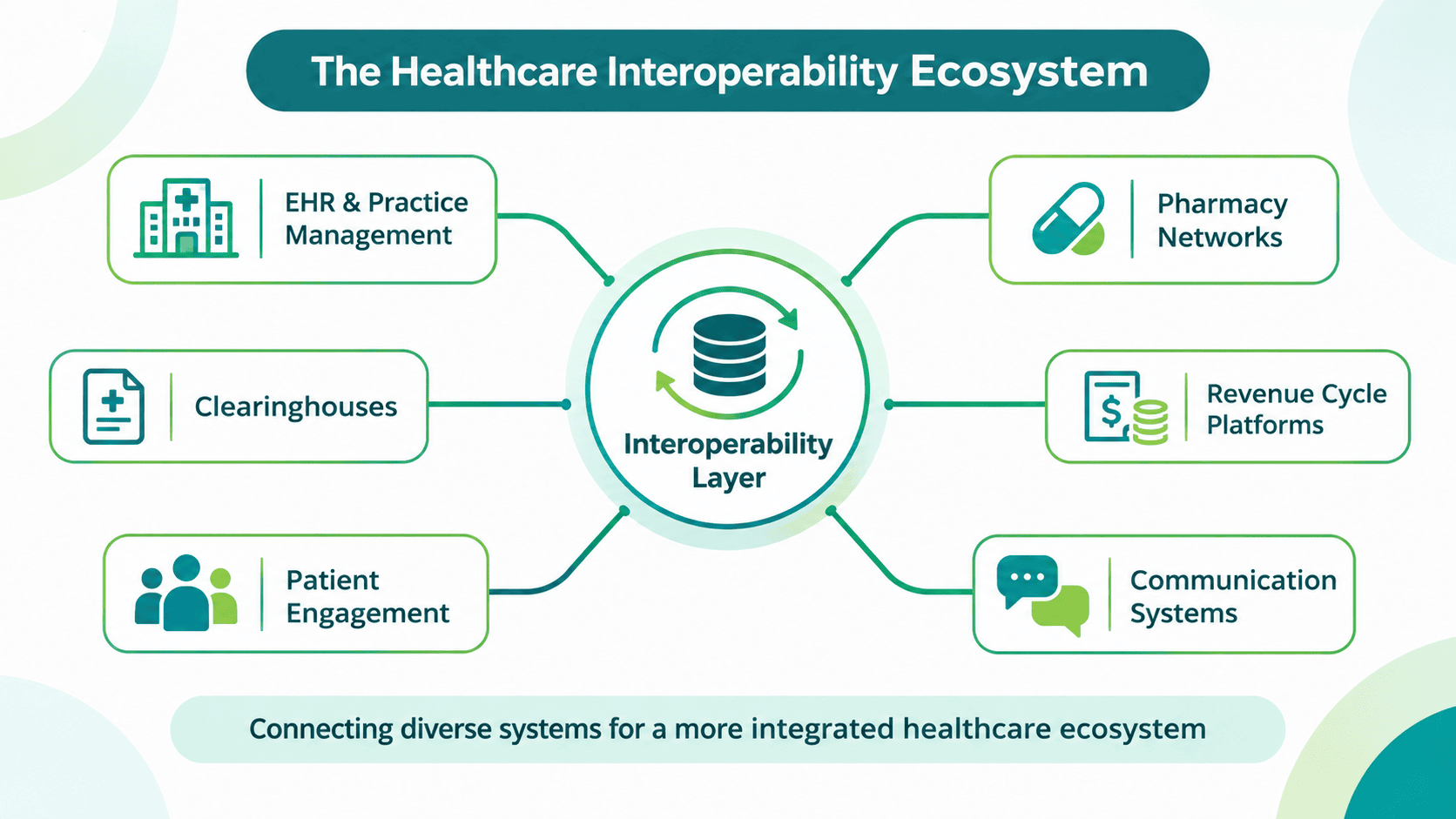
Healthcare interoperability is often discussed in terms of standards such as FHIR, HL7, and APIs. In practice, however, healthcare interoperability solutions are rarely about standards alone. Successful interoperability solutions in healthcare require organizations to connect diverse healthcare ecosystems, manage vendor-specific requirements, and ensure clinical, operational, and financial workflows remain synchronized across systems.
As healthcare organizations increasingly adopt patient engagement platforms, digital front doors, AI-powered applications, and specialized healthcare solutions, healthcare data interoperability has become a business necessity rather than a technical convenience.
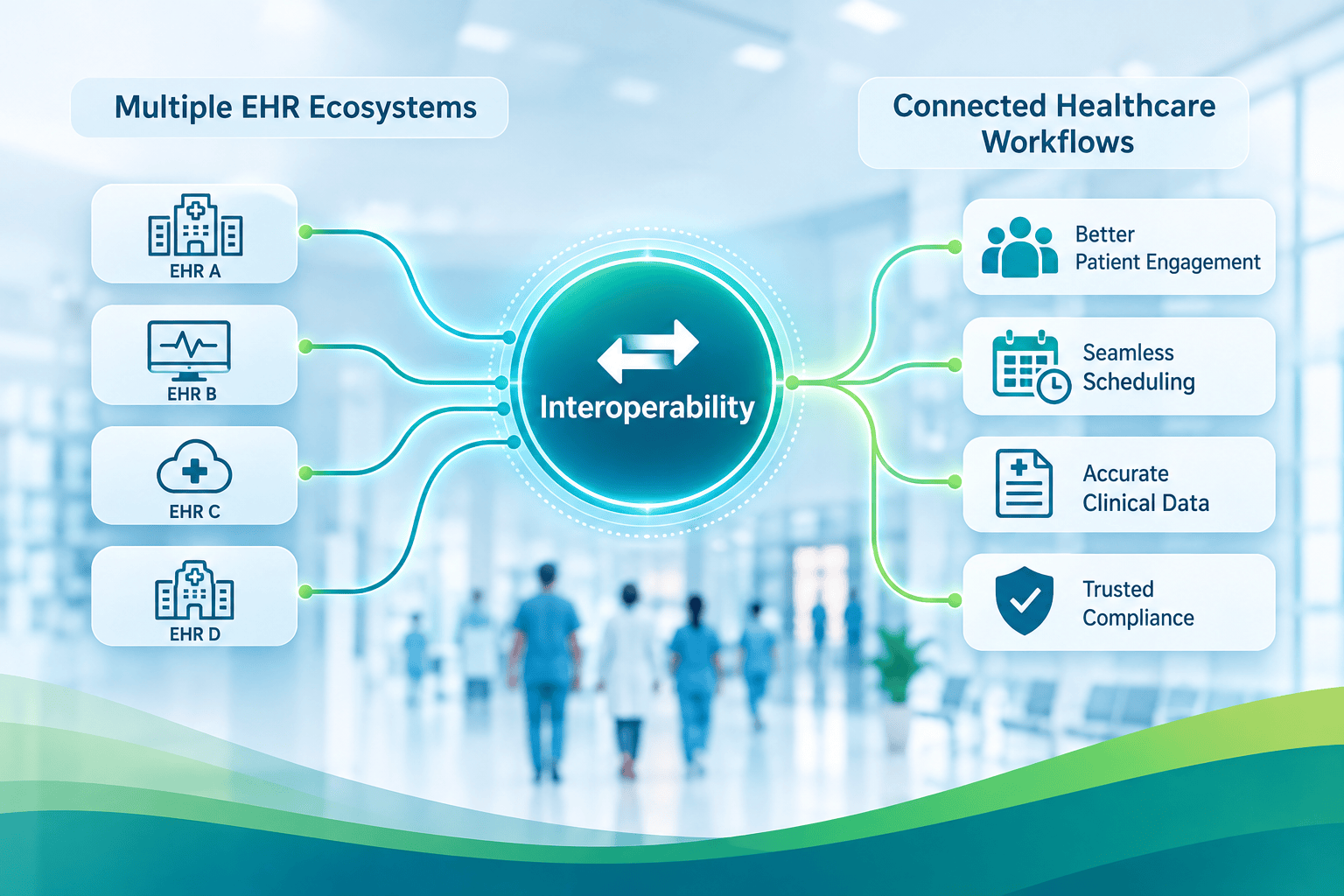
Why Healthcare Data Interoperability Matters in Multi-EHR Environments
Many healthcare technology vendors assume that integrating with one EHR prepares them for integration with others. Unfortunately, every EHR ecosystem introduces unique interoperability requirements.
While some platforms support FHIR-based integration, organizations often encounter workflow requirements that extend beyond standard APIs. Other platforms may rely on proprietary APIs, vendor-specific data models, custom workflows, or a combination of HL7 messaging and modern API-based interfaces.
As a result, healthcare interoperability solutions often need to support a diverse interoperability landscape that includes:
- FHIR APIs
- SMART on FHIR workflows
- HL7 messaging
- Vendor-specific REST APIs
- Proprietary integration interfaces
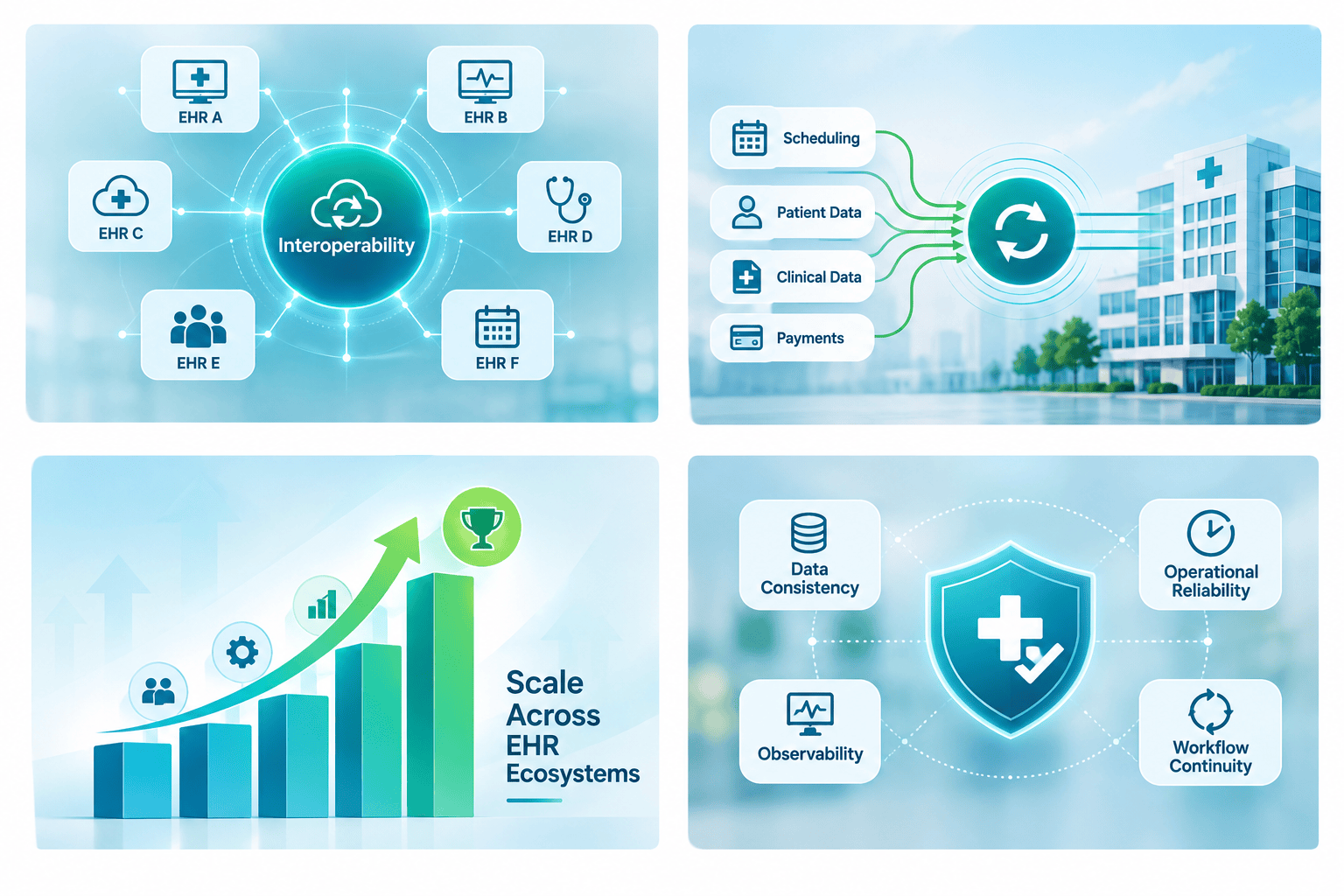
- Financial and scheduling workflows
- Clinical data synchronization

Common Healthcare Data Interoperability Challenges Across EHR Ecosystems
- Different APIs for Similar Workflows
Although many EHRs support similar business processes, the underlying integration approach can vary significantly.
Patient scheduling, registration, intake, payments, insurance verification, and clinical documentation may all require different APIs, authentication approaches, and workflow implementations depending on the EHR platform.
This variability is one of the most common challenges organizations face when implementing healthcare interoperability solutions. - Maintaining Data Consistency Across Systems
Healthcare organizations depend on accurate patient, appointment, insurance, financial, and clinical information.
When data moves between patient engagement platforms and EHR systems, organizations must ensure:
• Patient identities remain synchronized
• Appointments remain current
• Clinical information stays consistent
• Financial data remains accurate
• Workflow status is aligned across applications
Without effective healthcare data interoperability, inconsistencies can quickly create operational and administrative challenges. - Balancing Standards-Based and Proprietary Integrations
FHIR has significantly advanced healthcare interoperability. However, many healthcare workflows still depend on vendor-specific capabilities.
Organizations frequently need to combine:
• FHIR standards
• SMART on FHIR workflows
• Proprietary APIs
• Legacy interfaces
• Custom business logic
The most successful interoperability solutions in healthcare embrace both standards-based and platform-specific integration strategies. - Scaling Across Multiple EHR Platforms
Supporting one integration is manageable. Supporting multiple EHR ecosystems simultaneously is significantly more complex.
Healthcare technology vendors often need to support customers operating across multiple EHR platforms while maintaining a consistent product experience.
Without scalable healthcare interoperability solutions, onboarding new customers can become increasingly expensive and time-consuming. - Overcoming Data Quality, Legacy Systems, and Operational Barriers
While API connectivity often receives the most attention, many interoperability initiatives face challenges that extend beyond technical integration. Organizations frequently encounter inconsistent data definitions, duplicate patient records, legacy on-premises applications, and fragmented data repositories that make information exchange more difficult. In addition, vendor lock-in, implementation costs, cybersecurity requirements, HIPAA compliance obligations, and evolving privacy regulations can increase project complexity. Healthcare organizations must also carefully manage workflow changes to minimize disruption for clinicians and administrative staff while ensuring interoperability initiatives deliver measurable operational value.
Best Practices for Building Scalable Healthcare Interoperability Solutions
Build Around a Canonical Data Model
Instead of creating custom logic for every EHR platform, organizations can implement a common internal data model that standardizes information across systems.
This approach simplifies data interoperability in healthcare while reducing complexity and accelerating future integrations.
Invest in Reusable Integration Frameworks
Reusable integration frameworks help accelerate deployment and improve consistency across projects.
These frameworks can simplify:
- Data transformation
- Authentication
- Error handling
- Workflow orchestration
- Monitoring and recovery
Modern healthcare applications frequently need to:
- Retrieve patient information
- Update clinical information and patient care plans
- Update appointments
- Exchange clinical data
- Synchronize financial information
- Support provider workflows
Plan for Platform Variability

Lessons Learned from Real-World Healthcare Interoperability Projects
Organizations pursuing interoperability initiatives should view integration not as a one-time project but as a long-term strategic capability. Across healthcare interoperability projects involving patient engagement platforms, eligibility verification solutions, clinical intake workflows, medication management systems, patient payment applications, and multi-EHR integrations, several recurring lessons consistently emerge.
Interoperability Requires More Than Standards
While standards such as FHIR, HL7, SMART on FHIR, and X12 provide an essential foundation, real-world healthcare environments rarely operate on standards alone. Successful interoperability programs typically combine standards-based integrations with vendor-specific APIs, proprietary interfaces, platform-specific workflows, and custom business rules. Organizations should plan for this reality early in the design process rather than assuming a standards-only approach will meet every requirement.
Reusable Integration Frameworks Drive Scalability
As organizations expand support across multiple EHR ecosystems, maintaining separate integration architectures for each platform quickly becomes difficult to manage. A reusable interoperability framework built around canonical data models, shared services, and abstraction layers can reduce implementation effort, accelerate onboarding, simplify migrations, and improve long-term maintainability.
Workflow Integration Is as Important as Data Exchange
One of the most common misconceptions about interoperability is that successful data exchange alone creates business value. In practice, healthcare workflows often require validation, reconciliation, auditability, transaction tracking, exception handling, and provider review processes before data can be safely incorporated into operational or clinical systems. Effective interoperability solutions account for both information exchange and workflow integration.
Observability and Reliability Must Be Built In
As transaction volumes grow, operational reliability becomes increasingly important. Eligibility transactions, scheduling updates, prescription workflows, patient communications, clinical information exchanges, and financial transactions all depend on accurate and timely processing. Monitoring, transaction tracing, automated retry mechanisms, exception management, and recovery workflows help ensure interoperability platforms remain dependable at scale.
Design for Change from Day One
Healthcare ecosystems continue to evolve through new EHR capabilities, regulatory requirements, interoperability standards, mergers, acquisitions, and changing customer expectations. Organizations that build flexible, loosely coupled interoperability architectures are better positioned to support future integrations, adapt to new technologies, and respond to changing business needs without significant redesign efforts.
Ultimately, the organizations that succeed are those that treat interoperability as an enterprise capability rather than a collection of individual interfaces. By combining standards-based interoperability, reusable architecture, strong governance, and operational resilience, healthcare organizations can build scalable interoperability solutions capable of supporting evolving healthcare ecosystems over the long term.

Author
-
View all postsGanesh is a FHIAS- and PAHM-certified healthcare expert with special interest in patient engagement platforms and digital healthcare-related solutions. Has extensive experience in the US healthcare payer, provider, and PBM landscapes across different healthcare systems.