
The Cost of a 5 Min Delay: 5 Actionable Ways to Improve Medical Office Efficiency & Remove Bottlenecks
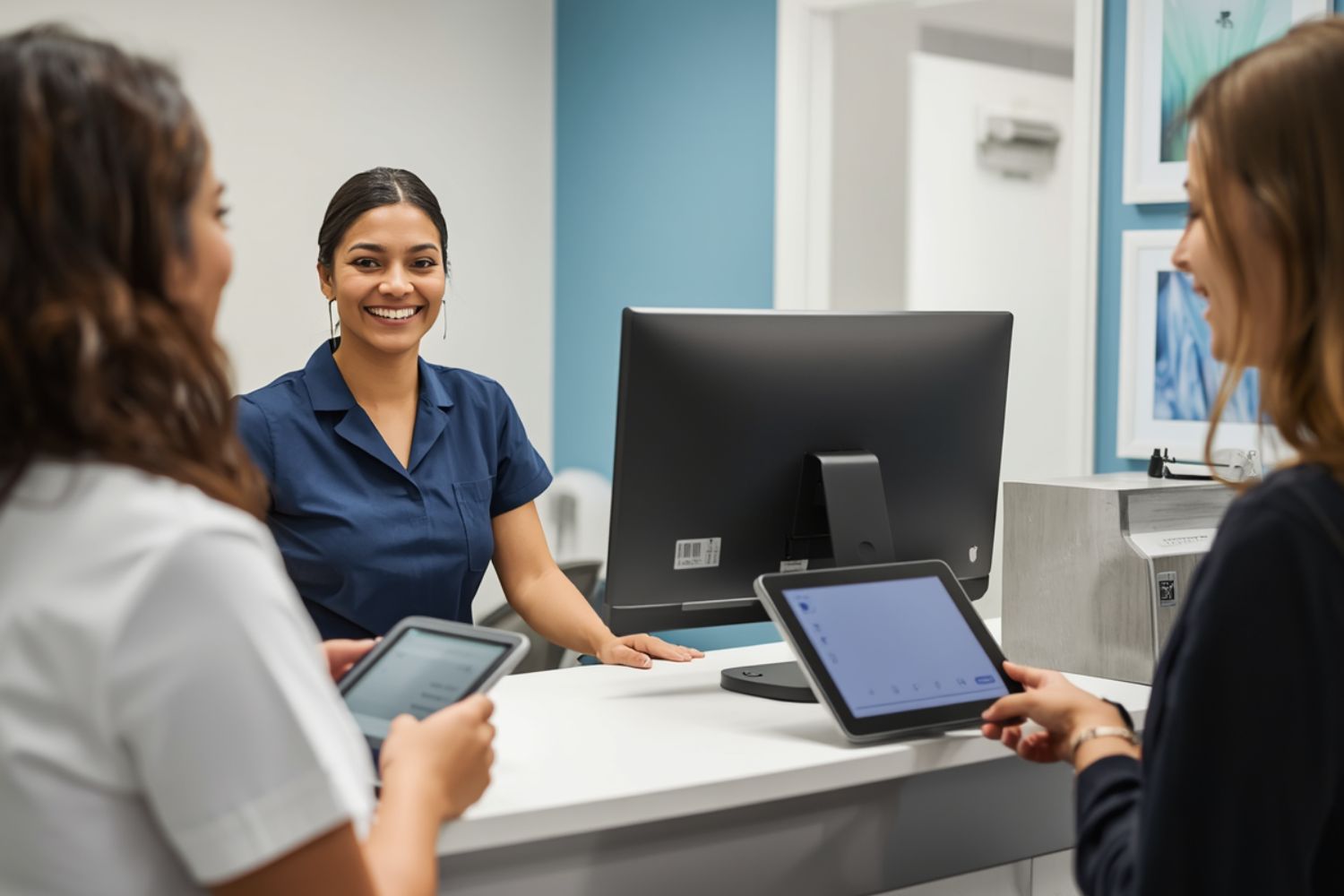
A patient arrives at the practice. Their paperwork isn’t complete. The front desk needs to collect information, verify details, and enter data into the system. Meanwhile, another patient is waiting in line, a medical assistant is preparing for the next appointment, and the provider’s schedule is already beginning to slip.
None of these delays may seem significant on its own.
But that is how medical office efficiency takes a hit: not through one major operational failure, but through small bottlenecks repeated across every patient visit.
Five extra minutes at check-in adds up to hours of lost staff time over a week. Manual data entry delays the next stage of care. Incomplete information creates more work for clinical teams. And ultimately, patients pay the price with longer wait times and a more frustrating experience.
The bigger question is what causes those five minutes in the first place, and what it takes to start improving medical office efficiency. Let’s take a look.
The Ripple Effect: When a Small Bottleneck Becomes Everyone’s Problem
Inefficiency at one point in the patient journey rarely stays there.
Inefficiency at one point in the patient journey rarely stays there.
Think about it this way: if check-in takes an extra 10 minutes per patient, a practice seeing 50 patients a day could lose more than eight hours of cumulative staff and patient time. Multiply those delays across front-desk staff, medical assistants, and clinicians, and small inefficiencies can quickly become a serious drain on capacity and productivity.
And it’s rarely one big problem. It’s the paper form that has to be scanned into the EHR. It’s the MA who has to ask the same intake questions the patient just answered on a form. It’s the insurance verification that runs on the wrong co-pay because the data didn’t sync, and the reminder that never went out, so the patient simply didn’t show up.
Each of these is a small friction point. Together, they create bottlenecks that tax everyone in the practice and every patient who walks through the door.
So, what actually removes them?
Here are 5 effective ways to improving medical office efficiency, drawn from three practices that changed where and how these inefficiencies crop up.
- Let patients complete their intake before the visit:
One of the biggest lessons in medical office efficiency is that the front desk shouldn’t have to do everything when patients arrive. The most efficient workflows move appropriate tasks earlier in the journey.
Take one of our customers, Alaska Orthopedic Specialists. Their patients were arriving 30 to 40 minutes early just to complete lengthy paperwork. At the same time, front-desk staff manually entered demographics into the EHR, while clinicians reviewed and captured medical history themselves.
The practice didn’t solve the problem by asking staff to work faster. Instead, it changed where and how the work happened.
With digital pre-registration, patients came prepared, completing their intake before the visit. Their demographics and payments flowed directly into the EHR. The result they saw eventually was a 70% reduction in patient wait times and a process that was 3x faster at getting patients to the exam room.
- Give patients flexible self-service check-in options
Not every patient will complete intake ahead of time, and that’s okay. The goal is to give them choices and convenience, so the front desk isn’t the only path.
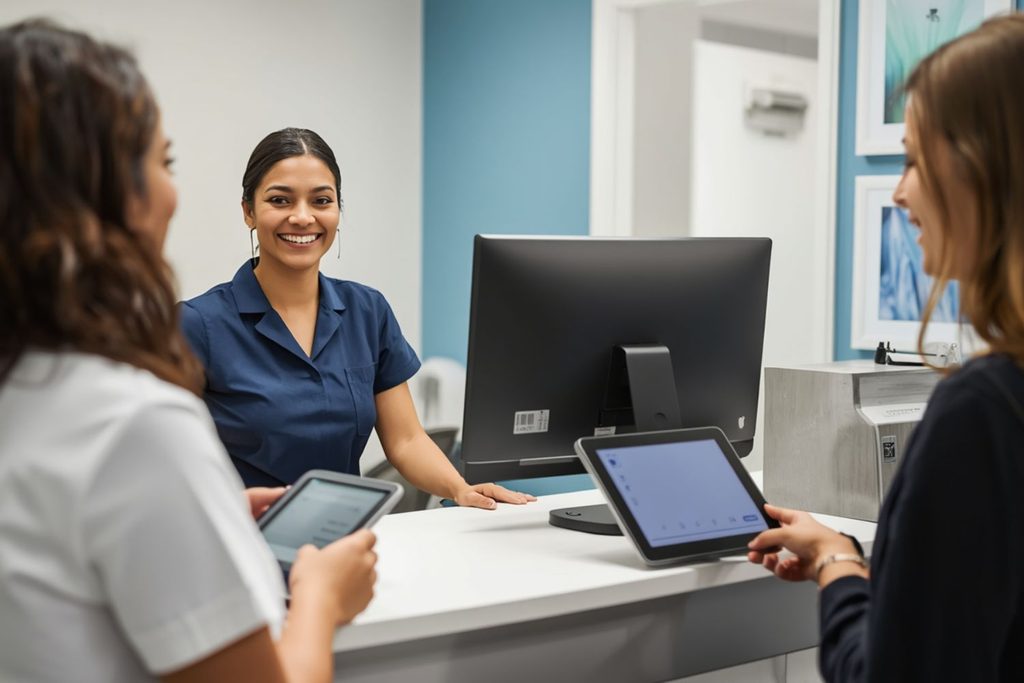
Alaska Orthopedics offered on-site options like self-serve kiosks and iPads for patients who hadn’t pre-registered. While Knoxville Pediatrics also took a similar approach, with three ways for guardians to complete intake: pre-registration links before the visit, QR-code check-in for same-day appointments, and assisted iPad check-in for those who needed a hand.
That flexibility matters. Before going digital, parents of sick children often had to juggle paperwork while dealing with an uncomfortable or fussy child in the waiting room. Giving them options made the experience easier for families and lighter for staff.
- Automate repetitive assessments and paperwork
Before digitizing its workflow, one of CheckinAsyst customer, the Knoxville Pediatrics team spent hours manually preparing screening forms, grading and scanning them, and getting information ready for clinicians.
After the transition, the system automatically triggered the right ASQ-3 assessment, scored it, and sent the information to the EHR.
As a result, the practice saved a whopping 15 to 20 minutes per patient. The front desk saved 4 hours per week on form preparation, and clinicians saved nearly 30 minutes daily.
Therefore, medical office efficiency isn’t just about shortening the check-in line. It’s about removing repetitive work throughout the patient journey.
- Send patient records straight into the existing EHR/PM fields:
Technology can digitize a process without making it efficient. True efficiency comes from improving the entire workflow, not just digitizing individual tasks, as Memphis Neurology, one of our customers, learned firsthand.
With their previous intake solution, patients completed forms digitally, but the information reached the EHR just as PDFs. MAs still had to manually enter clinical data into the appropriate fields before the provider could see the patient.
Although the paper was gone, the bottleneck was still there.
After switching to CheckinAsyst, patient data flowed into the appropriate EHR fields instead of requiring manual re-entry. As a result, MAs saved 5–10 minutes of clinical time per patient, and the practice eventually operated with 40% fewer clinical and front-office staff while increasing patient volume by 25%.
- Connect the entire patient journey as one workflow:
Across these three practices mentioned above, the strategy was remarkably consistent.
They moved appropriate tasks before the appointment. They gave patients self-service options. They automated repetitive workflows, and they reduced the need for staff to repeatedly enter, scan, organize, or chase information.
Most importantly, they made sure information could move through the workflow instead of getting stuck at every transition.
That’s where CheckinAsyst became a game changer.
Each of these practices came to CheckinAsyst from a different starting point. One still relied heavily on manual processes. Another was struggling with time-consuming assessments and intake workflows. And one had gone digital but was still dealt with bottlenecks caused by disconnected data.
What they all needed was more than a solution for one isolated task. They needed a way for improving medical office efficiency as a connected workflow. Rather than simply replacing paper forms with digital ones, CheckinAsyst helped these practices redesign inefficient processes around the patient journey, from pre-registration and check-in to clinical assessments and EHR documentation.
In a busy medical office, a few lost minutes may not seem like much. But when those minutes are lost across every patient, every day, the cost adds up quickly. And when those bottlenecks are removed, the efficiency gained can change far more than the first 15 minutes of a visit. It can change how the entire practice operates.
Schedule a demo to see how a connected, unified workflow can streamline the patient journey and improve medical office efficency and go through these case studies on our website to discover interesting customer stories.